











9 Hours
30
1 Year
Arranged location
This full-day private archaeological tour from Cairo to Tanis and Bubastis offers an in-depth exploration of one of the most complex and least understood regions in ancient Egypt: the Nile Delta.
Unlike the monumental landscapes of Luxor or Giza, the Delta preserves a different type of historical record. It is not a landscape of monumental preservation, but a landscape of political transformation, fragmentation, adaptation, and cultural layering.
The Nile Delta served as the economic foundation of ancient Egypt due to its agricultural fertility and strategic waterways. It was also a geopolitical frontier connecting Egypt with the Levant and the broader ancient Near East.
Within this environment, cities such as Tanis and Bubastis emerged not as marginal settlements but as critical centers of political authority and religious identity during different phases of Egyptian history.
Tanis represents a phase of decentralization in which regional dynasties established new capitals while attempting to preserve ideological continuity with earlier imperial traditions. Bubastis represents a different dimension of Egyptian civilization, where religion became more socially integrated, emotionally expressive, and publicly participatory.
This tour is designed as a structured historical narrative rather than a simple visit to ruins. Each location contributes to a broader understanding of how ancient Egypt functioned as a multi-centered civilization rather than a single unified capital-based system.
Tour Highlights
Tanis – Political Authority in a Fragmented Era
Explore the archaeological remains of one of the most important Delta capitals of the Third Intermediate Period. Understand how political power shifted from Upper Egypt to Lower Egypt and how rulers of Tanis constructed legitimacy through architectural reuse and religious continuity.
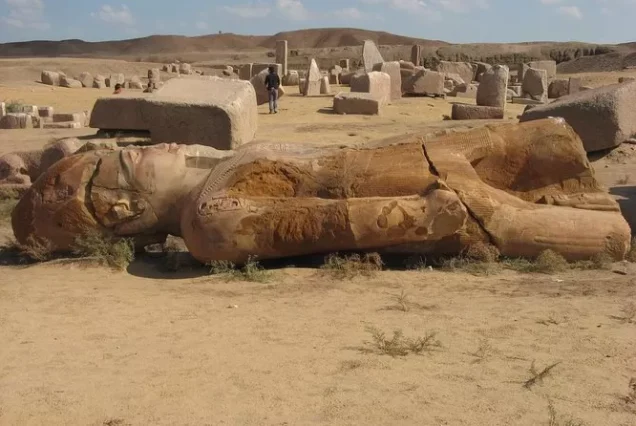
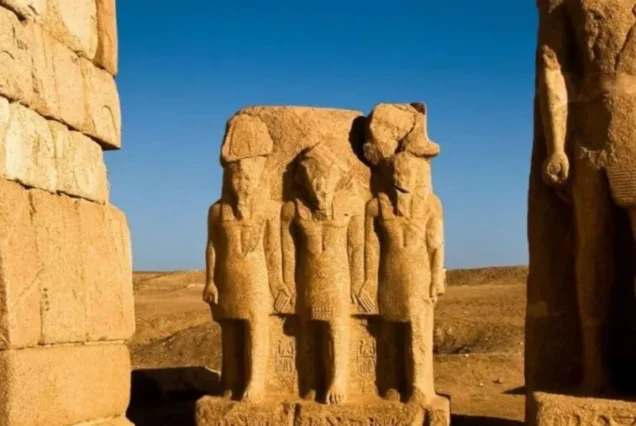
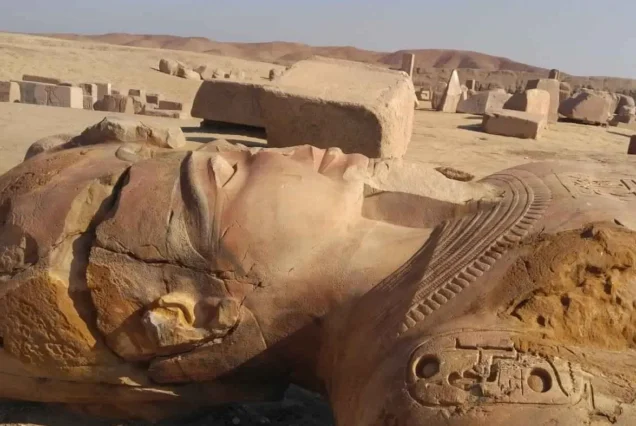
Examine massive statues, temple remains, and royal tombs that reflect a period of political decentralization and cultural adaptation.
Bubastis – Religion as Social Structure
Visit the sacred city of Bastet, where religion extended beyond ritual into collective social identity. Understand how Bastet worship evolved from a protective lioness deity into a symbol of domestic life, joy, and fertility.
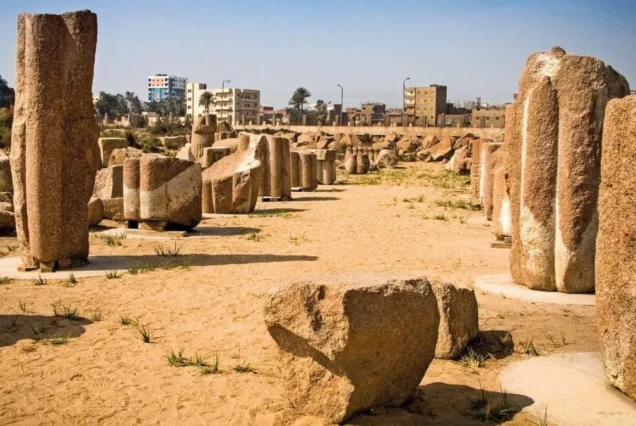
Explore archaeological remains of temple precincts that once hosted large-scale public festivals involving music, processions, and communal participation.
Nile Delta Geopolitical System
Understand the Delta as a strategic region that controlled agriculture, trade routes, and communication networks between Egypt and neighboring civilizations.
Historical Continuity and Cultural Transition
Examine how Tanis and Bubastis reflect different aspects of the same historical system: political adaptation and religious transformation.
Important Pickup Information
Pickup and drop-off are included from hotels located in Cairo and Giza.
However, pickup or drop-off from the following locations will require an additional transfer fee due to the longer distance from the main tour route:
Cairo International Airport Sphinx International Airport New Administrative Capital
New Cairo Heliopolis
Badr City Shorouk City El Rehab City
Obour City Sheraton Al Matar
Sheikh Zayed City Madinaty
These areas are located farther from central Cairo and Giza, and therefore additional transportation costs may apply.
Add-ons:
One-way transfer from/to Cairo Airport: $25
Round-trip transfer from/to Cairo Airport: $60
The journey begins with departure from Cairo. As the city recedes, the environment transitions into the agricultural landscape of the Nile Delta. This transition is not only geographical but historical, as it marks the shift from modern urban Egypt to one of the oldest continuously cultivated regions in the world.
Your guide introduces the concept of Lower Egypt as a historical system defined by waterways, fertility, and strategic control.
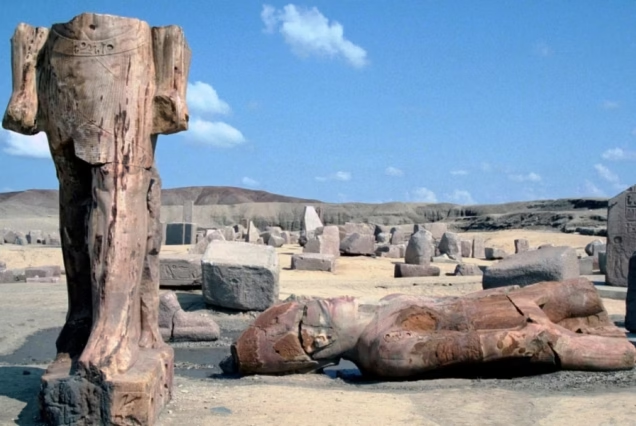
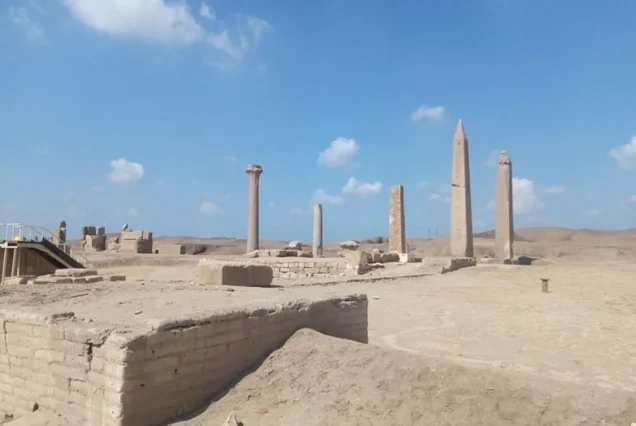
Arrival at Tanis introduces a landscape that differs fundamentally from traditional monumental sites. Instead of restored temples or reconstructed architecture, the visitor encounters fragmented remains distributed across a vast archaeological field.
The site includes:
Massive granite statues of Ramesside rulers
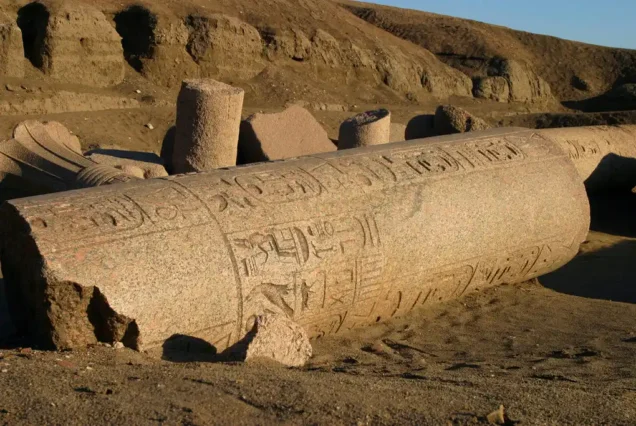
Displaced obelisks originally from earlier capitals
Temple foundations dedicated to Amun and associated triads
Royal tomb structures discovered in relatively intact conditions
The guide explains the political logic behind Tanis as a capital established during a period of weakened central authority. Emphasis is placed on the reuse of earlier monumental materials as a symbolic strategy of legitimacy.
Late Morning: Bubastis – Archaeology of Popular Religion
The journey continues to Bubastis, where the archaeological focus shifts from political authority to religious practice.
The site reveals temple layouts dedicated to Bastet, including ceremonial spaces and structural remains associated with ritual activity.
The interpretation focuses on:
The evolution of Bastet’s religious identity
The role of festivals in reinforcing social cohesion
The integration of religion into daily life structures
A traditional meal is served within the Nile Delta region. This setting reflects the agricultural environment that historically supported ancient Egyptian civilization.
During the return journey, the guide synthesizes the historical relationship between Tanis and Bubastis, emphasizing how the Nile Delta functioned as a dual system of political and religious organization.
1. The Nile Delta as a Structural Civilization Zone
The Nile Delta should not be interpreted as a peripheral region. Instead, it functioned as a structural core of ancient Egyptian civilization due to its agricultural productivity, population density, and strategic positioning.
The Delta was divided into multiple administrative nomes, each functioning as semi-autonomous units within the broader state system. This decentralized structure allowed for regional capitals such as Tanis to emerge during periods of weakened central authority.
Unlike Upper Egypt, where monumental continuity dominates the archaeological record, the Delta preserves a more dynamic pattern of settlement, abandonment, and reuse. This reflects the fluid political nature of the region.
2. Tanis and the Political Logic of Reuse
One of the most significant features of Tanis is the systematic reuse of earlier monumental architecture. This phenomenon is not random but reflects a deliberate ideological framework.
By relocating statues, obelisks, and temple elements from earlier capitals, rulers of Tanis were constructing a physical connection to the legitimacy of past dynasties.
This practice, known in archaeological interpretation as architectural spolia, serves three main functions:
Political legitimacy through association with past kings
Economic efficiency in a resource-limited period
Religious continuity through preserved sacred objects
The royal tombs discovered at Tanis provide further insight into this system. Unlike the hidden tombs of the New Kingdom, these burials were integrated into the urban landscape, reflecting a different conception of kingship and afterlife.
The preservation of grave goods in these tombs has significantly expanded modern understanding of Third Intermediate Period material culture.
3. Bubastis and the Anthropology of Ritual Emotion
Bubastis represents a critical case study in the anthropology of ancient religion. Unlike elite-focused cults centered on royal authority, the cult of Bastet reflects widespread popular participation.
The transformation of Bastet from a lioness war deity into a domestic protective figure indicates a shift in religious psychology. This transformation aligns with broader socio-political changes in which stability, protection, and daily life became central concerns.
Festival activity at Bubastis, described in classical sources, suggests a highly structured form of ritualized celebration. These events likely served multiple functions:
Reinforcement of communal identity
Regulation of agricultural cycles
Redistribution of religious authority across social groups
This makes Bubastis one of the most important sites for understanding non-elite religious experience in ancient Egypt.
4. Political Fragmentation and Cultural Continuity
The coexistence of Tanis and Bubastis during overlapping historical periods demonstrates that ancient Egypt was not a unified monolithic system but a network of interconnected regional centers.
During periods of political fragmentation, cultural continuity was maintained through religious institutions rather than centralized administration.
This explains why cities like Tanis could emerge as political capitals while still preserving Theban religious traditions, and why Bubastis could function as a major cult center independent of political authority.
5. The Delta as a Contact Zone of Civilizations
The Nile Delta also functioned as a contact zone between Egypt and neighboring civilizations, particularly those of the Levant and Eastern Mediterranean.
This interaction influenced:
Trade systems
Military strategies
Cultural exchange
Linguistic diffusion
As a result, Delta cities often display hybrid characteristics that reflect cross-cultural integration.
6. Reinterpreting Egyptian Civilization Through Regional Lenses
Traditional Egyptology has often emphasized Upper Egyptian monumental centers as the core of civilization. However, the study of Tanis and Bubastis demonstrates the necessity of a regional approach.
Ancient Egypt functioned as a multi-centered system in which:
Political authority shifted geographically over time
Religious practices varied by region
Economic systems were regionally specialized
This perspective fundamentally changes how Egyptian civilization is understood in modern scholarship.
Conclusion
This tour is not simply an archaeological visit. It is an interpretive framework for understanding how ancient Egypt functioned as a complex, adaptive, and regionally diverse civilization.
Tanis and Bubastis together represent two complementary expressions of this system: one political, one religious, both deeply embedded in the geography and history of the Nile Delta.
Yes. This tour is specifically designed for travelers who are interested in archaeology, ancient Egyptian political history, and religious evolution. It is not a general sightseeing experience but an interpretive historical journey.
The tour requires moderate walking on uneven archaeological terrain. The sites are open-air and not fully developed like major tourist attractions, so comfortable walking shoes are recommended.
No. Both sites are among the least crowded major archaeological locations in Egypt. This allows for a quiet and uninterrupted exploration experience.
→ Morning
All transfers are provided in a modern, air-conditioned private vehicle.
Yes, completely safe with a professional guide.
Yes, it is family-friendly and for all ages,especially for educational purposes
Yes, with additional cost.
Yes, the tour is fully flexible.
Yes, lunch is included at a local restaurant.
This is a fully private tour. All transportation, guiding, and timing are customized to the traveler.
Cairo traffic can be unpredictable, but маршруtes are strategically planned to optimize time efficiency.
Depending on timing, guides may introduce lesser-known architectural details and viewpoints not typically included in standard itineraries.
Yes. The experience is designed to meet premium travel standards, including private transport and personalized service.
Entrance fees are not included.
The ideal time to take this tour is between October and April when temperatures are moderate and suitable for outdoor archaeological exploration.
Comfortable clothing suitable for warm weather is recommended. Lightweight fabrics, hats, and sunglasses are strongly advised. Modest clothing is also recommended due to rural and cultural environments.
Footwear Recommendation
Walking shoes with good grip are essential due to uneven terrain at archaeological sites.
The Nile Delta offers a very different visual environment compared to Upper Egypt. Natural light conditions are soft, and open landscapes allow for wide-angle archaeological photography.
Visitors should respect rural customs in Delta villages. Photography of local residents should be done only with permission.
It is important to stay hydrated throughout the tour due to limited shaded areas at excavation sites.
This experience is distinct from mainstream Egypt itineraries for several reasons.
First, it focuses on a geographical region that is rarely included in standard tourism routes. The Nile Delta remains one of the least visited yet historically most significant areas of ancient Egypt.
Second, the tour combines political history and religious anthropology in a single narrative structure, rather than treating sites as isolated monuments.
Third, the archaeological condition of both Tanis and Bubastis provides a rare opportunity to observe ancient sites in a relatively unmodified state, without heavy reconstruction or modern reinterpretation.
Fourth, the experience emphasizes interpretation rather than presentation. Travelers are not simply shown ruins; they are guided through historical processes, political transformations, and cultural evolution.
This makes the tour especially valuable for repeat visitors to Egypt who have already seen major sites such as Luxor, Aswan, and Giza and are now seeking deeper intellectual engagement.
The importance of Tanis and Bubastis lies not in architectural grandeur alone, but in their ability to represent entire historical systems.
Tanis reflects a phase of Egyptian history characterized by decentralization, regional governance, and symbolic continuity with earlier dynasties.
Bubastis reflects the integration of religion into social lifewhere divine worship extended beyond temples into communal identity and public celebration.
Together, they demonstrate that ancient Egypt was not static but continuously evolving, adapting its political and religious systems to changing historical conditions.
The Nile Delta served as the stage on which these transformations occurred, making it one of the most important yet underrepresented regions in Egyptological studies.
Expert Interpretation Value
This tour is designed not only as a physical journey but also as an intellectual framework for understanding ancient Egyptian civilization.
It introduces key concepts such as:
Political fragmentation and regional power structures
Architectural reuse as ideological expression
Religious evolution from elite-centered to popular participation
The role of geography in shaping historical development
Multi-centered civilization theory in ancient Egypt
These concepts are essential for a deeper academic understanding of Egyptian history beyond standard tourist narratives.
This experience is ideal for:
Cultural travelers seeking non-mainstream destinations
History enthusiasts with interest in ancient civilizations
Repeat visitors to Egypt looking for advanced content
Academic or semi-academic travelers
Photographers interested in archaeological landscapes
Travelers seeking quiet, uncrowded historical environments
Practical Experience Value
Beyond its historical depth, this tour provides a highly practical travel experience.
It offers:
Private transportation for full comfort
Professional Egyptologist interpretation
Flexible pacing depending on interest level
Direct access to remote archaeological regions
Structured storytelling instead of fragmented site visits
This combination of comfort and intellectual depth makes it a premium alternative to standard group tours.
Final Conceptual Insight
The journey to Tanis and Bubastis reveals an essential truth about ancient Egypt:
Civilization did not exist as a single center of power but as a network of interconnected regions, each contributing differently to political authority, religious life, and cultural development.
The Nile Delta, often overlooked in favor of Upper Egypt, emerges here as a foundational space of transformation, continuity, and adaptation.
Understanding Tanis and Bubastis therefore means understanding Egypt not as a static civilization of monuments, but as a living system of evolving historical forces.
This tour offers access to one of the most historically significant yet least explored regions of ancient Egypt.
It is not a standard excursion but a structured archaeological and historical interpretation of the Nile Delta civilization.
For travelers seeking depth, meaning, and authenticity beyond conventional tourism routes, this experience provides a rare opportunity to engage with Egypt at a more advanced intellectual level.
Book your private Tanis and Bubastis tour from Cairo to explore the hidden foundations of ancient Egyptian civilization in a way that few travelers ever experience.






Reviews
There are no reviews yet.